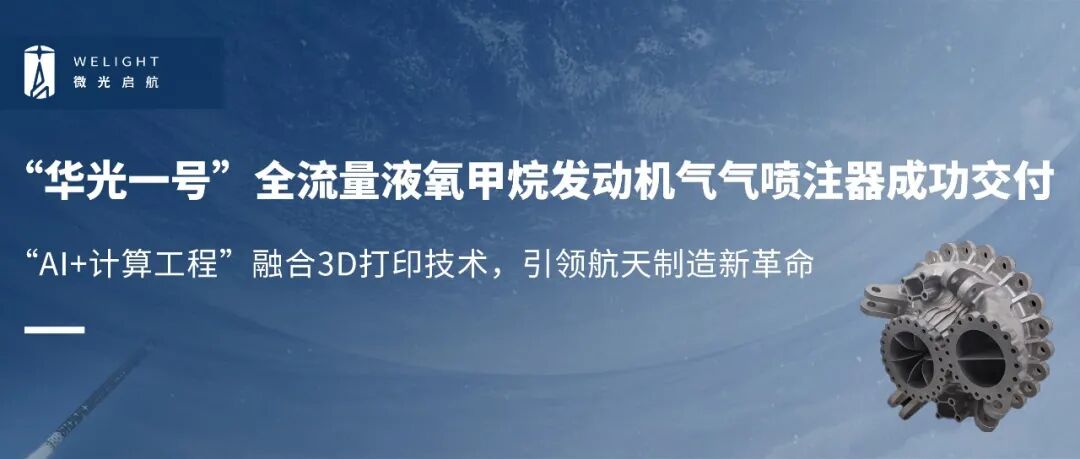
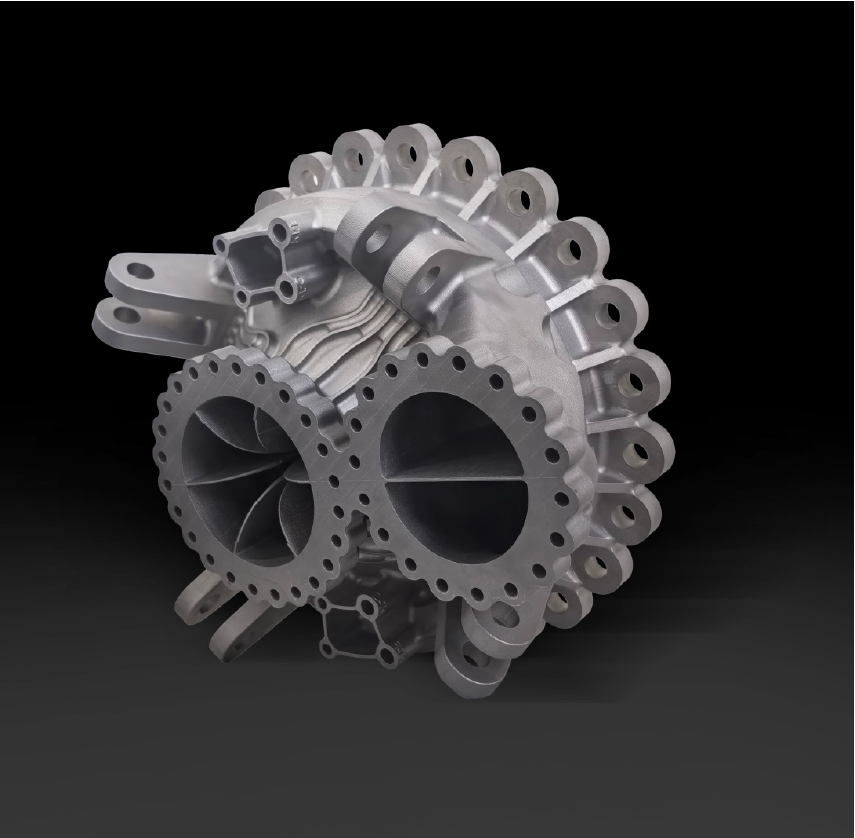
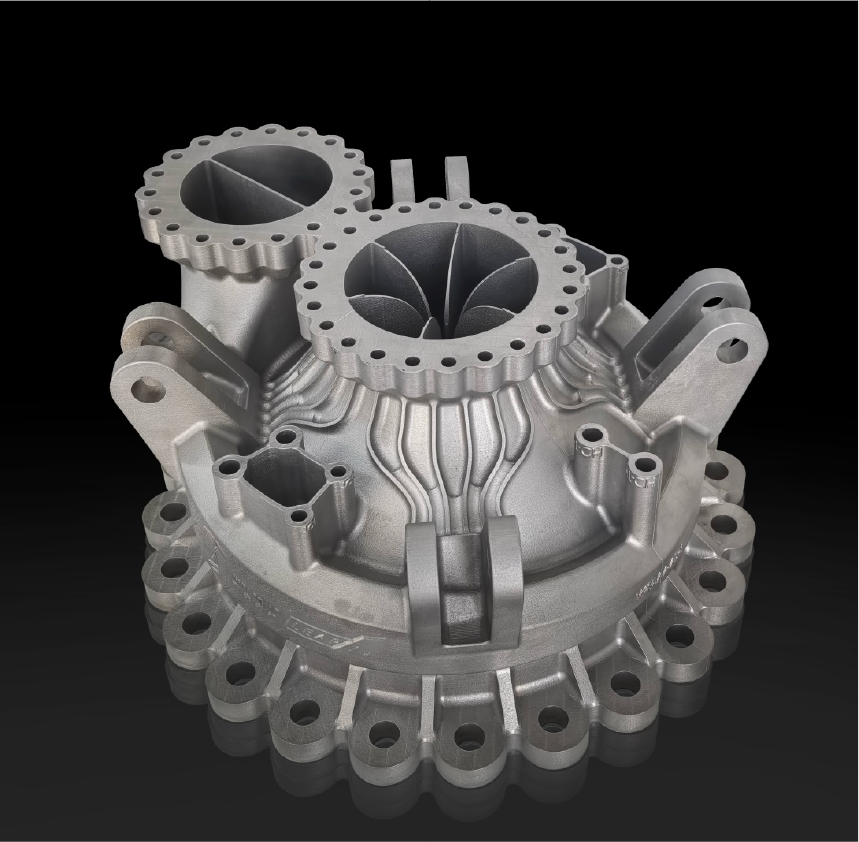
Recently, a major advancement in China's aerospace propulsion technology has been achieved – the "Blaze-1" engine gas-gas injector, independently developed by WeLight, has been successfully manufactured and officially delivered. This injector innovatively adopts an integrated "AI + computational engineering + 3D printing" design and forming solution, achieving a 98% reduction in part count, a 70% shorter development cycle, and an 80% cost reduction. It is the first additively manufactured gas-gas injector applied to liquid rocket engine development and production in China. This marks a new era of intelligent, integrated, and efficient manufacturing for China's aerospace core components.
Technological Breakthrough: From "Hundreds of Parts Assembly" to "Integrated One-Piece Forming"
Traditional liquid rocket engine injectors are typically assembled from hundreds of precision parts, resulting in complex structures, long manufacturing cycles, high assembly precision requirements, and challenges such as numerous welds, heavy weight, and dispersed reliability risks.
The "Blaze-1" gas-gas injector, through deep integration of artificial intelligence, computational engineering, and advanced metal 3D printing technology, achieves an innovative monolithic structural design:
AI + Computational Engineering-Driven Design Optimization
Based on simulation and computational engineering, the system automatically performs multiple iterative optimizations to generate the optimal flow channel structure and internal topology, significantly reducing structural weight while ensuring fuel mixing efficiency and cooling performance.
Support-Free Integrated Printing
By generating slice files that eliminate the need for traditional supports through computational engineering, metal 3D printing directly produces a single, continuous structure – integrating hundreds of conventional parts into one unified body, completely eliminating assembly steps.
Significantly Enhanced Reliability
Eliminates numerous welds and connection interfaces, reducing potential leak paths and fatigue failure points, significantly improving engine operational stability and service life.
Weight Reduction Breakthrough
Topology optimization and monolithic structure significantly reduce component weight, contributing to improved rocket launch efficiency and mission adaptability.
Dramatically Shortened Manufacturing Cycle
Fully digitalized and automated from design to finished product, eliminating multi-part machining, inspection, and assembly processes, reducing development cycle by over 50%.
Flexible Customizable Performance
Computational engineering models can rapidly adjust design parameters based on different mission requirements, enabling flexible adaptation of injector performance to support diversified engine model development.
The "Blaze-1" full-flow LOX/methane engine gas-gas injector features a coaxial shear design, offering outstanding propellant mixing, high combustion efficiency, uniform thermal loading, simplified structure, and superior manufacturability.
"The successful development of the Blaze-1 gas-gas injector is not only a major milestone for WeLight in aerospace propulsion, but also provides a new technological paradigm for global aerospace manufacturing. It transforms the traditional long-cycle iteration of 'design – prototyping – testing' into an efficient closed loop of 'model-driven – simulation optimization – intelligent manufacturing', injecting strong momentum into the development of propulsion systems for China's commercial space and deep-space exploration."
WeLight stated that this integrated forming technology will be extended to more critical engine components such as turbopumps and thrust chambers, and will gradually build a full-process intelligent development system covering design, simulation, manufacturing, and inspection – supporting the continuous evolution of China's rocket engines toward higher performance, lower cost, and rapid responsiveness.