Breaking Conventional Mold Design Constraints for Large and Complex Structures
The first-stage fuel tank of the WELIGHT-1 launch vehicle has a nominal . Taking into account the performance characteristics and structural design requirements of carbon-fiber composites, WELIGHT adopted a stiffened structure comprising 90 longitudinal stringers and 18 circumferential frames. Focusing on the connection strength between the stringers and skin, the team achieved a breakthrough in integrated co-curing technology for large-scale, thin-walled stiffened structures.
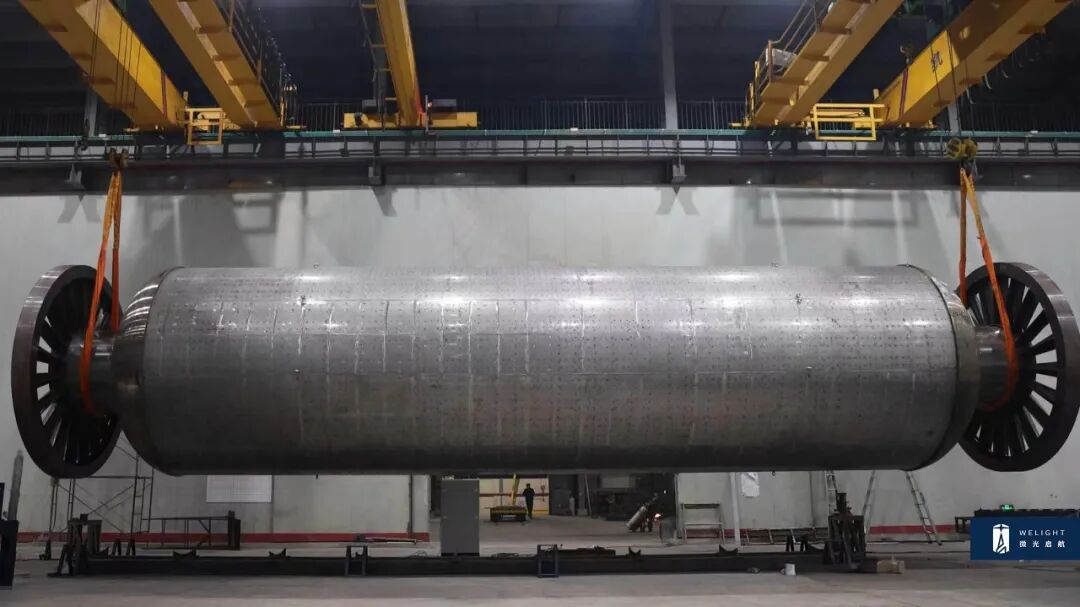
Photo: The first-stage fuel-tank forming mold for WELIGHT-1 successfully rolls off the production line
The complex product structure places even higher requirements on the forming mold. The mold must not only withstand operating conditions of 200°C and 0.7 MPa during composite autoclave processing, but also meet the weight and precision limitations of existing automated fiber placement equipment in China. The total weight of the complete mold system must therefore be kept below 20 tonnes.
If the mold were made entirely of stainless steel or carbon steel, the equivalent thickness of the segmented cylindrical sections and tank dome would have to be less than 10 mm in order to satisfy the overall weight constraint, making it difficult to simultaneously meet requirements for structural stiffness, forming accuracy, and equipment compatibility. To address this challenge, the team did not follow conventional metallic mold design concepts. Instead, it sought a solution through structural innovation itself. Following multiple rounds of design validation and optimization, the team ultimately pioneered a honeycomb sandwich structure without internal supports. This approach achieves high structural stiffness under strict weight constraints while limiting the mold's self-deflection to within 1.0 mm. All data, from structural design to precision control, meet the design requirements.
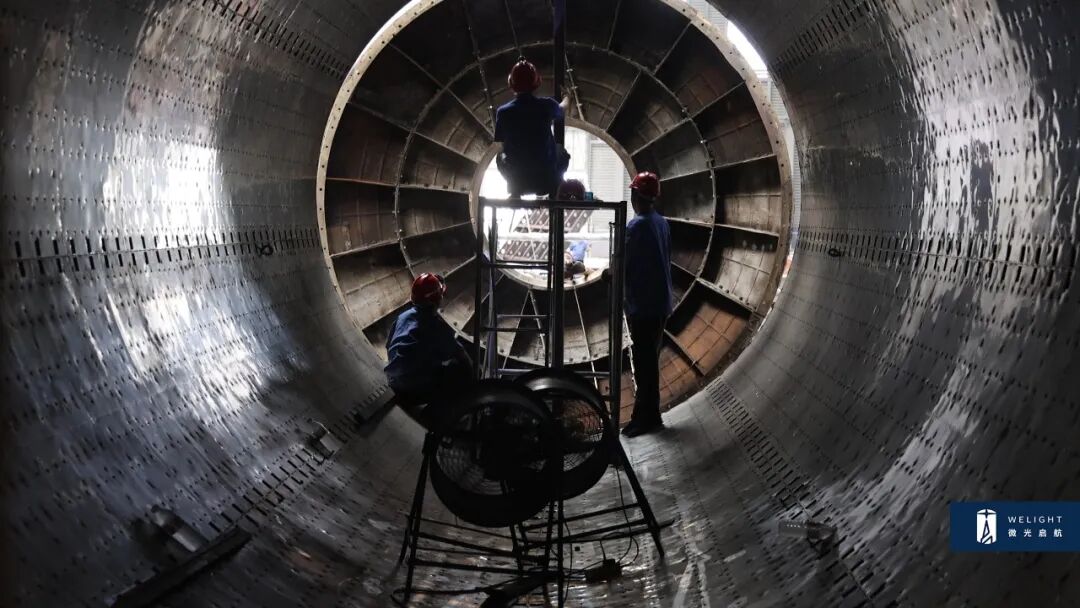
Photo: Internal structure of the WELIGHT-1 first-stage fuel-tank forming mold, featuring a honeycomb sandwich design without internal supports
From a Pioneering Tooling Breakthrough to Engineering-Scale Tank Manufacturing
For large composite tanks, the mold is not merely a manufacturing tool; it is a critical foundation for ensuring product forming quality, dimensional accuracy, and manufacturing consistency. In particular, for large-scale thin-walled stiffened structures, mold stiffness, precision, and reusability directly determine the stability and repeatability of subsequent manufacturing processes.
The successful completion of this forming mold marks a key breakthrough for WELIGHT in the lightweight and high-stiffness design and manufacturing of forming tooling for large all-carbon-fiber composite tanks, filling a technological gap in China's large all-carbon-fiber composite tank manufacturing sector.
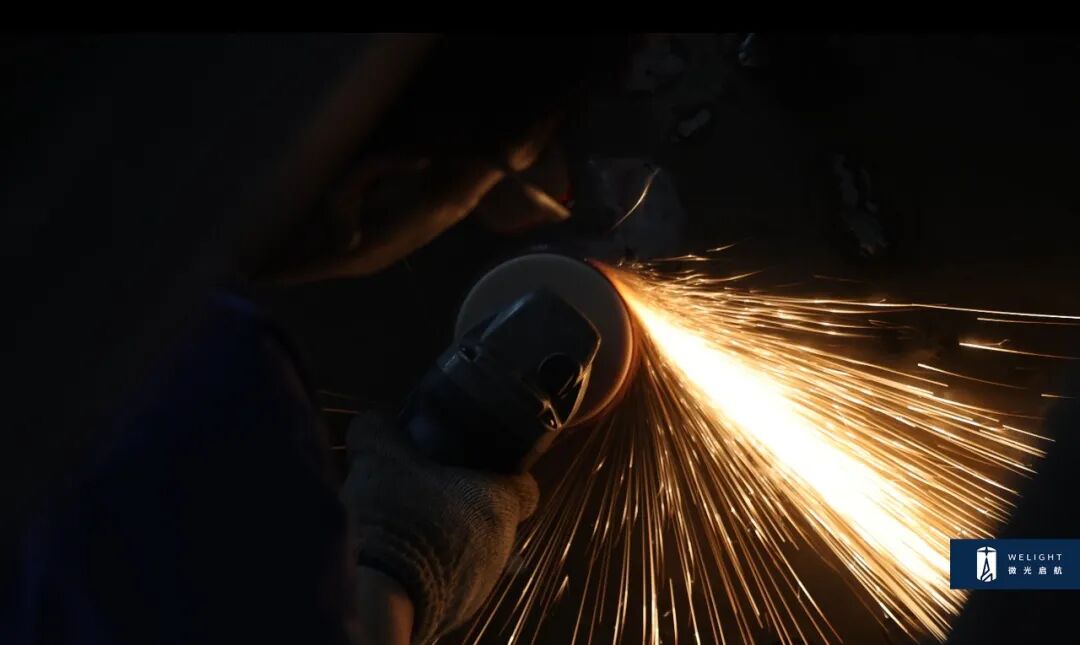
Photo: Manufacturing site of the WELIGHT-1 first-stage fuel-tank forming mold
From structural design to tooling development, and from process breakthroughs to engineering validation, true innovation goes beyond breakthroughs in individual technologies. More importantly, it lies in transforming material potential, structural advantages, and manufacturing capabilities into engineering achievements that are achievable, verifiable, and repeatable. In addressing the complex engineering challenges involved in developing large all-carbon-fiber launch vehicles, WELIGHT remains committed to solving manufacturing challenges through a systems-engineering approach and breaking through the constraints of conventional technological paths through independent innovation.
Where no mature precedent exists, answers are found through engineering practice; where no established path exists, new paths are created through systems-engineering innovation. WELIGHT will continue translating the advantages of composite-material technologies into improved launch-vehicle performance, higher manufacturing efficiency, and stronger engineering capabilities, exploring new possibilities for reusable launch vehicles and bringing space resources within reach.
Editor: Zhao Jiaqi
Proofreader: Chi Chunyang