
Coinciding with the 11th China Space Day, the 70th anniversary of China's space industry, and the 10th anniversary of the establishment of China Space Day, Beijing WeLight Technology Co., Ltd. (hereinafter referred to as "WeLight"), as an emerging force in China's commercial space sector, made its public debut at the conference. It showcased its core products – the "Spark-1" all-carbon-fiber launch vehicle, the "Blaze-1" full-flow staged combustion cycle LOX/methane engine, and the all-carbon-fiber common-dome tank – drawing widespread industry attention.
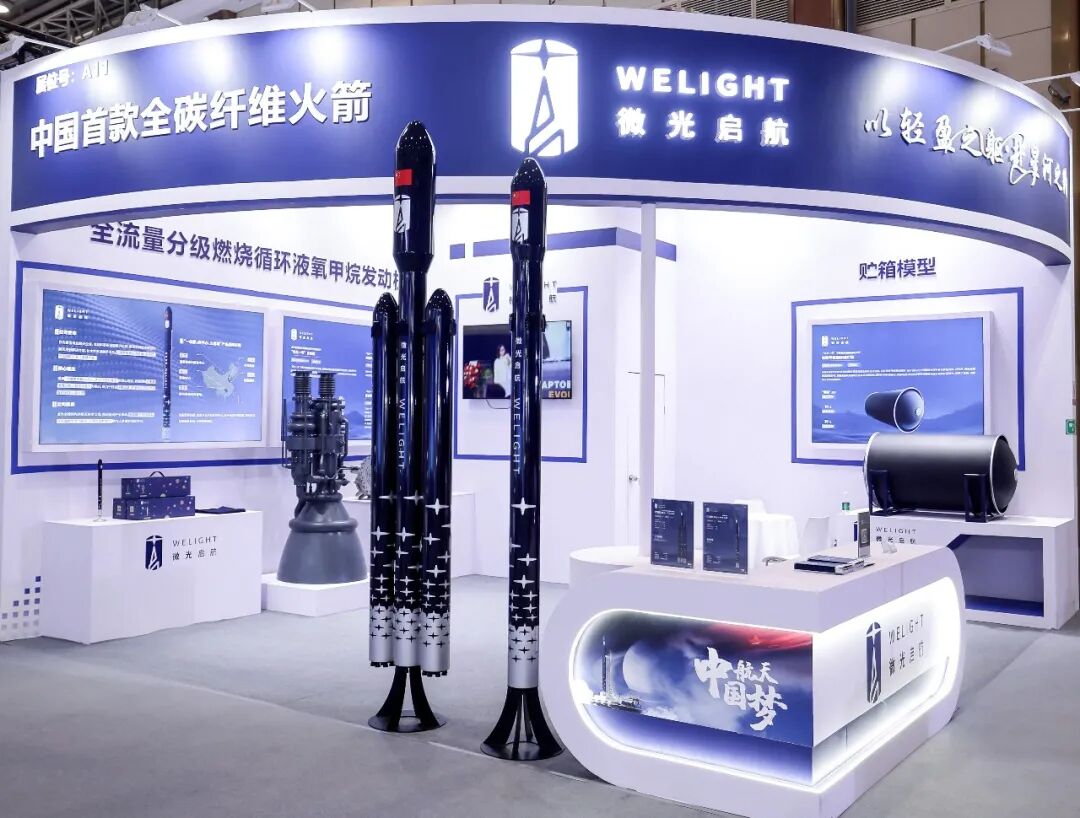
Figure | 2026 China Space Conference – WeLight Exhibition Booth Overview
During the conference, WeLight Founder and CEO Gao Huan delivered a keynote speech titled "Bringing Rockets Back to Business Essence: Doing the 'Addition' of the Space Economy with the 'Subtraction' of Composites." Starting from the physical and economic essence of rockets, the speech systematically elaborated the company's technological roadmap and business model of "reshaping economic boundaries through material innovation."
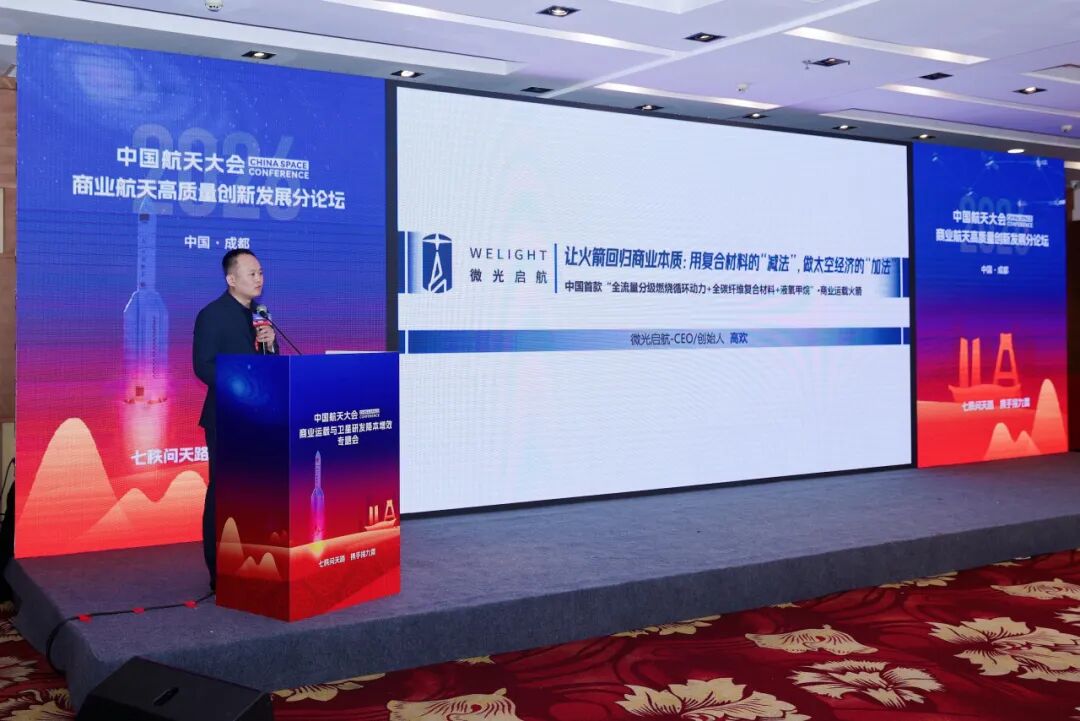
Figure | WeLight Founder and CEO Gao Huan delivering a speech

Materials + Propulsion Dual-Driven
Building the World's First All-Carbon-Fiber LOX/Methane Rocket
WeLight prominently featured the world's first commercial launch vehicle combining "full-flow staged combustion cycle propulsion + all-carbon-fiber composites + LOX/methane" – the Spark-1. The rocket extensively uses carbon-fiber composites in its structure, significantly reducing structural dry weight and directly addressing the core pain point of "cost per kilogram to orbit" from first principles.
In terms of propulsion, the company's independently developed Blaze-1 full-flow LOX/methane engine delivers 500 kN sea-level thrust, 582 kN vacuum thrust, a chamber pressure of 24 MPa, a thrust throttling range of 55%-106%, and a thrust-to-weight ratio exceeding 100. Its combustion efficiency reaches 99.2%, with a sea-level specific impulse of 323 seconds and a vacuum specific impulse of 376 seconds, placing its overall performance at the forefront internationally.
Core Exhibits Showcased, Demonstrating Full-Chain Technical Capabilities
At the WeLight booth, visitors could view up close:
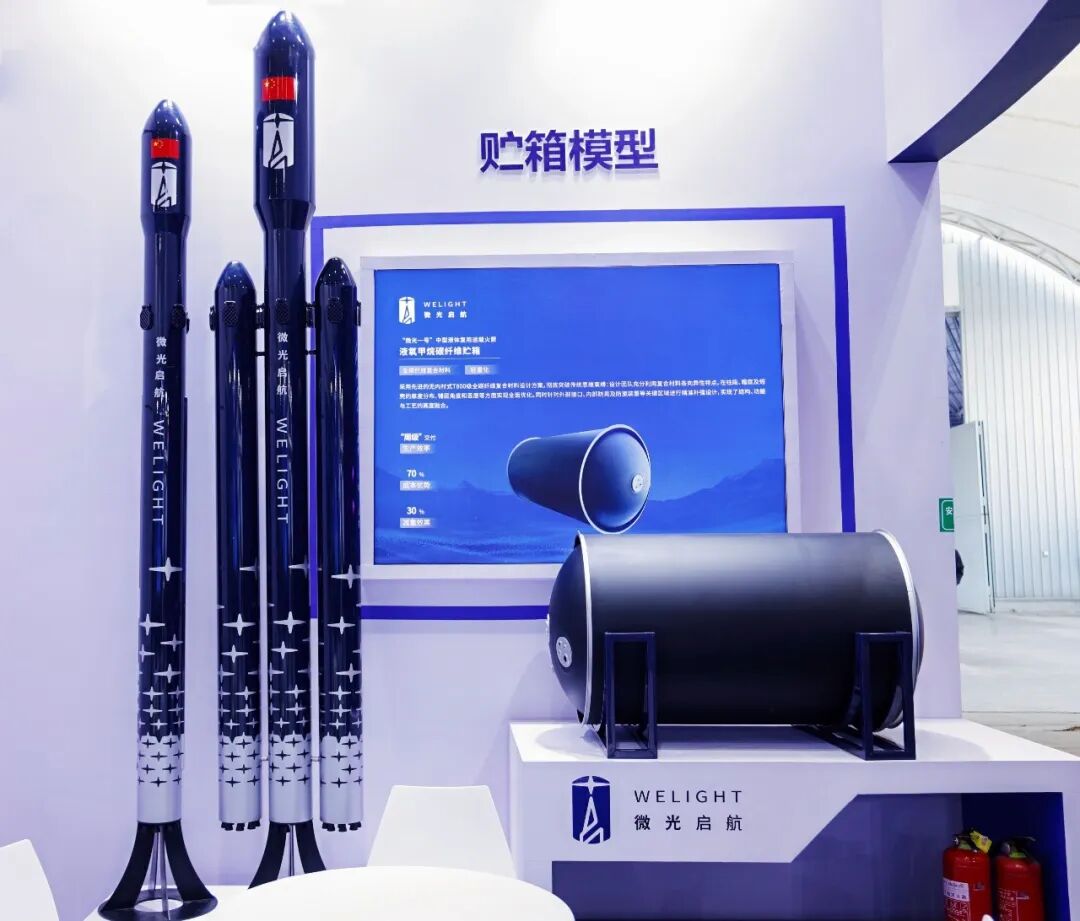
Figure | Spark-1 all-carbon-fiber launch vehicle model (left) + all-carbon-fiber tank model (right)
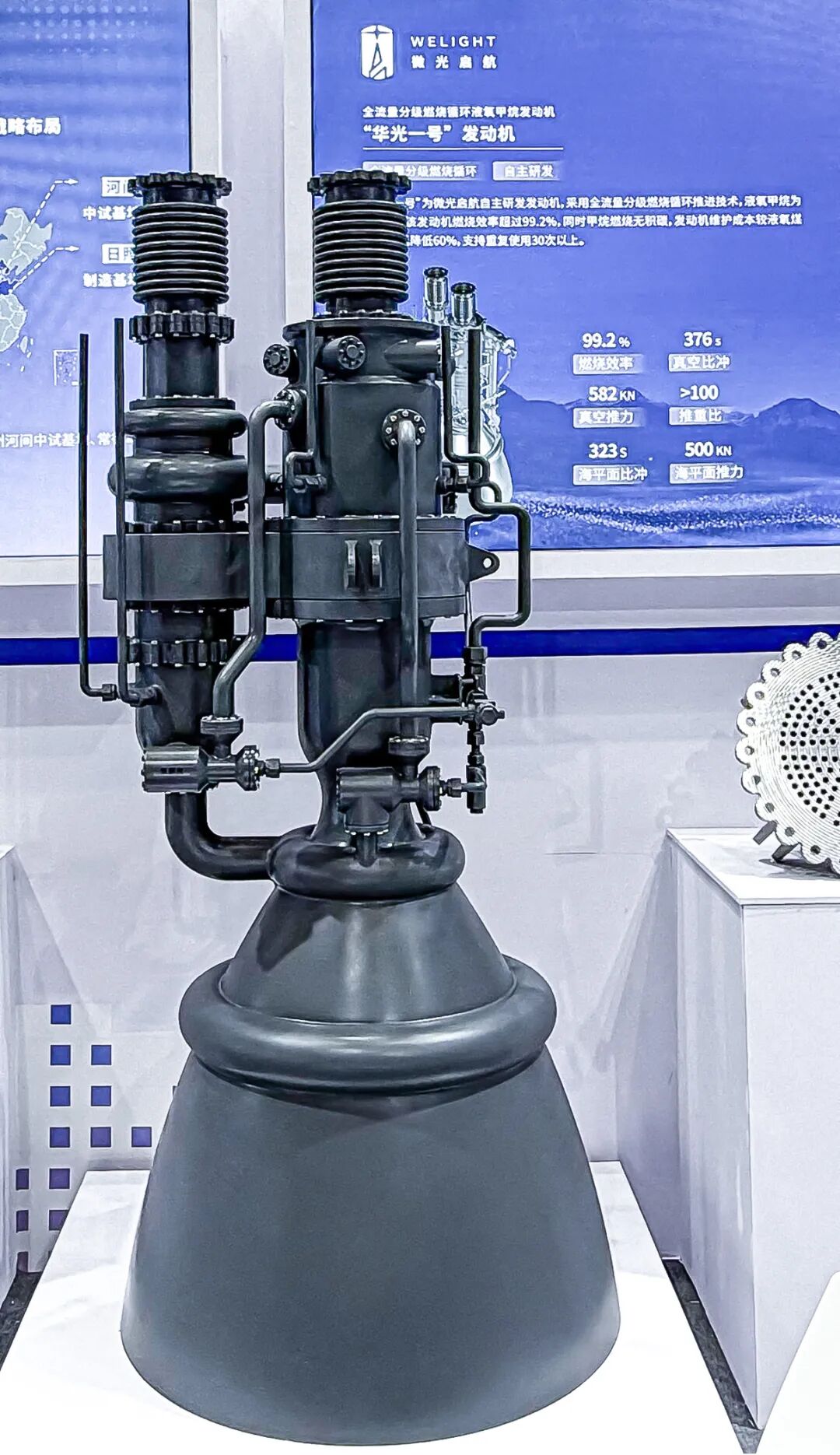
Figure | Blaze-1 full-flow staged combustion cycle LOX/methane engine model
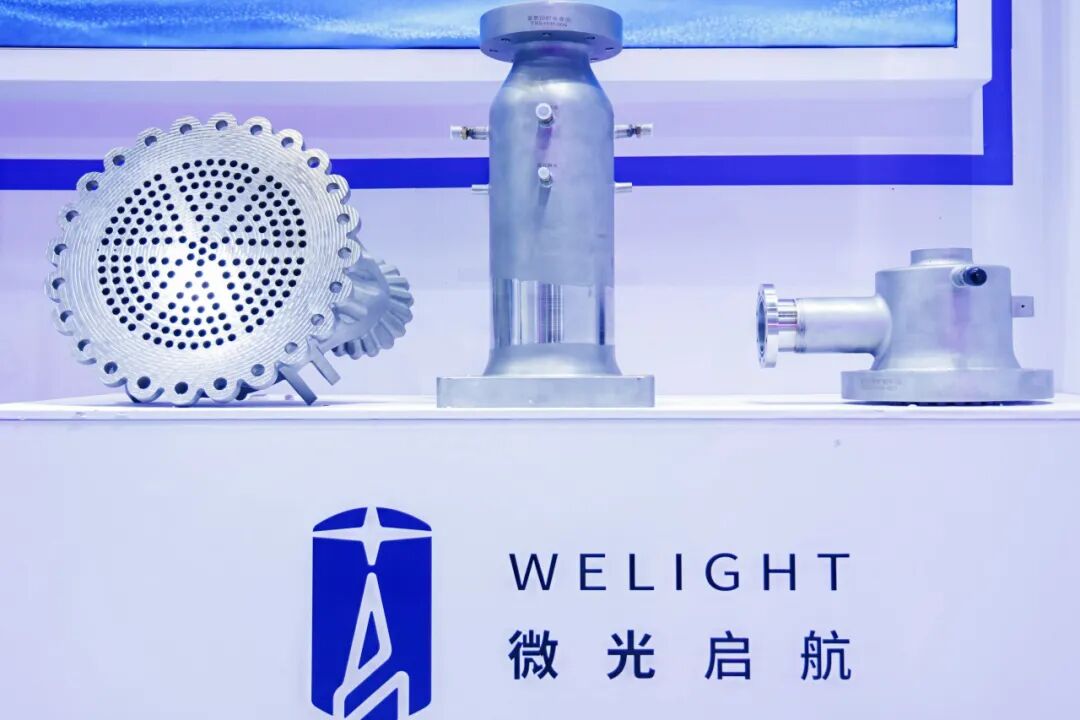
Figure | 3D-printed injector (engine core component) / leftmost, oxygen-rich pre-burner (engine core component) / right 1 + right 2
These exhibits systematically demonstrated WeLight's technical accumulation and engineering implementation capabilities in composite structures, advanced propulsion, intelligent manufacturing, and AI + computational engineering.
Begin with the End in Mind, Accelerating the "Moore's Law" of the Space Economy
Founded in 2025, WeLight adheres to the philosophy of "technological innovation as the core and commercial value as the driving force," and is committed to developing green, low-carbon, fully reusable liquid launch vehicles with independently controllable data. The company is accelerating the construction of its strategic layout of "one headquarters, two R&D centers, and three bases": Beijing operations headquarters, dual R&D centers in Beijing and Changsha, the Hejian pilot production base in Cangzhou, the Changde propulsion system test base, and the Rizhao manufacturing base.
Gao Huan pointed out in his speech: "Launch vehicles are not just transportation to space – they should become the 'Moore's Law carriers' of the space economy. We are doing the addition of the space economy through the subtraction of composites, continuously reducing the cost per kilogram to orbit and unlocking the core code of space commerce."
With the continued advancement of the Spark-1 project, WeLight plans to achieve its first flight by 2028 and gradually build high-frequency, low-cost, reusable space transportation capabilities, providing efficient and reliable launch services to global customers.